

Part 1
“The question of revolutionary tactics, however, would appear to be a sealed book for the leadership of PDAC. They should at least have the consistency of accusing Lenin and Trotsky of revisionism too.” -Francesco Giliani
https://www.marxist.com/improvisation-over-marxism-the-errors-of-the-morenoites.htm
From a Marxist standpoint, the negation of the negation of Lenin actually involves or develops Lenin’s ideas within the present situation. Without the first negation, the second negation could not take place and Lenin’s influence would be lost for future generations.
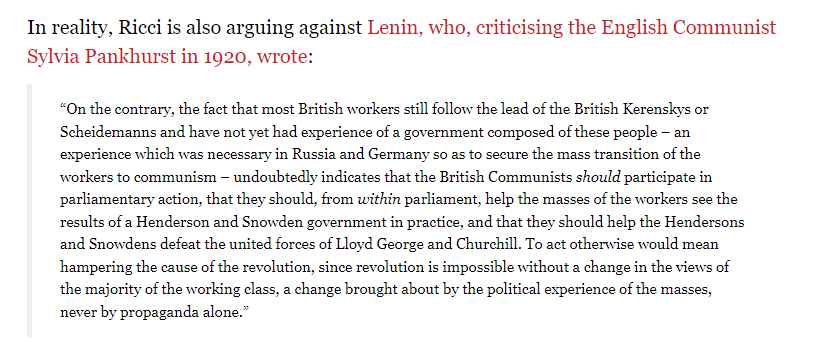
Furthermore, a ban on any writer’s contradiction of Lenin forces Lenin’s own ideas out of the discussion, since one part of Lenin contradicts another. Lenin views evolved and went through abrupt changes, and so those who rule out criticism end up with the position that Lenin’s ideas have no place in the present conflict. Only someone capable of contradicting Lenin, when he errs (as he did in his conflict with Pankhurst) or speaks about specific, unrelated contexts, can apply Lenin’s theories to practical organizational and theoretical-political work.
“Rather, he slanderously accuses us of having rejected the notion of the vanguard party… But there is a great distance that needs to be covered between proclaiming oneself to be a “party” and actually being one.”
https://www.marxist.com/improvisation-over-marxism-the-errors-of-the-morenoites.htm
We have another contradiction here that requires theoretical work to break down. The two sides appear divided over whether a revolutionary leader must emerge from the vanguard party itself or whether the revolutionary must encourage political changes outside of the party itself. The two sides have strong arguments negating one another. If a revolutionary leader does not need to come from within the Marxist party, then we waste whatever effort we spend on creating a revolutionary party. The encouragement itself could come from outside the party. This leads to economism and the view that the revolutionary has nothing to do.
In practice, however, the revolutionary party does not necessarily include every revolutionary leader. A prime example is Trotsky, who gained national recognition by leading the St. Petersburg Soviet in 1905, a known revolutionary, and someone who did not join the Bolshevik Party until 1917. His theories and writing prior to 1917 definitely hold value for present day revolutionaries, so what accounts for a leading revolutionary remaining outside the party for all those years? We can only resolve this issue by breaking down further the idea of inclusion. If a revolutionary party exists and a known revolutionary leader does not join, then the concept of inclusion should reach beyond official membership.
A record of the contacts between the revolutionary party and the revolutionary will reveal not only a revolutionary but also a party bureaucracy guilty of excluding the best comrades so as to promote one another. We see this in the rise of Stalin through the ranks of the Bolsheviks despite the capable leadership of Lenin. In fact, one might wonder why the revolutionary leader would join the party at all. Joining the Bolsheviks, even at the top, did not give Trotsky the power to overcome the bureaucracy. We can even argue that Trotsky could have formed a new opposition party to defend democratic rights in the Soviet Union, but he did not because he saw internal party conflict as the only (and coincidentally ineffective) means of fighting the bureaucracy.
The converse may also be true. The party could act nobly and professionally as an organization. They could make every effort to accommodate for the specific needs of a supposed revolutionary leader. Their efforts to recruit may be in vain, but in going through the process they have exposed a false leader for the working class to see. Such false leaders, produced in excess by the class conflict, are a threat to democracy and to the working class in particular as the oppressed class.
Conflict between these ideas gives rise to a problem in Lenin’s thought that overemphasized military analogies in politics. The party formation takes the territory, the capital, almost like a military unit. If fighting for or against a military unit, the best tactic is not to join the attacking unit and attempt to create internal conflict. Only confronting the party with a superior force and dictating the terms of an agreement will force the party to conform to a certain model of behavior or to certain goals and methods. In most cases, that superior force would be the state, giving them the final say. When Lenin’s party comes into contact with the state, the state will inevitably impose its own rules. We have to demand fair rules or allow for a confrontation between the party and the revolutionary army, something Trotsky prevented to the detriment of party democracy. Only then can different factions emerge. In our case, the conflict around the SEP, IMT, and others will require a larger movement that does not let up until all their democratic centralist, i.e., socialist party organizational, demands are met. A new revolutionary army, once formed, must start immediately with the task of dividing the party or parties into factions to defend free discussion and to permanently divide the political bureaucracy.
That means defending the rights of members and recruits to appeal expulsions or rejections. A further appeal would allow them to take the matter to the entire membership for discussion and a vote. At the same time, we need to defend the right to immediate recall. Furthermore still, we need to set net worth caps on the entire executive board of the party. Also, the membership should have free political movement between factions. No more, “They trained you already, so we do not need you.” These and other acts cannot conceivably pass as party policy without a confrontation with a larger force that dictates these terms as part of their surrendering of the party.
We have a precedent for this because of the ever-present military analogies. In Europe in Marx’s time and throughout the world both before and since, not only individual parties but entire national parliaments have succumbed to threats and redivisions by military force. Also at present, we have the threat of a fascist coup from a movement composed of active and ex-military. We cannot allow them to control the party with threats and violence without any rejoinder from our side.
We simply have to convince these new revolutionary forces that the emergency powers granted to the Nanobureaucracy in the 1980s, in the aftermath of Healy’s fall, no longer hold effect. A reorganization and redivision of the party imposed by force will actually provide for a more democratic outcome.
In the meantime, as this situation develops, civilian force has an important role to play as well. A long campaign to change leadership will have a corrosive effect on the Stalinist structure, making the demolition a far simpler task. Furthermore, the establishment of an alternative leadership from outside the party will draw the best revolutionaries away from the internalized oppressive forces of Stalinist reaction.
As a revolutionary party, the SEP, IMT, and others have the responsibility to call for an armed insurrection at some point and defend the legality of armed insurrection in theory. Whenever the topic of armed insurrection comes up, Democratic Power should be there to demand an armed insurrection to change the party’s own leadership. That would give the party an insurrectionist leadership. Conservatives in the party will argue that this only gives support to the reaction. In fact, it denies support to the reaction because the predatory and criminal nature of those who conquered the party from Trotskyism in the 80s now threaten a much larger section of the population. Instead of waiting for fascists to destroy the party permanently in the name of destroying the predator, we have to have a controlled destruction that leads immediately and seamlessly to reconstruction.
Part 2 (unfinished)
In an online chat with an IMT recruit, I wrote:
“North joined Healy’s group but under the influence of the same social forces as the SWP leadership. He gave in to Stalinism through its approach to party politics: purges, slander, and leader-worship.”
https://randomposter33.org/2023/09/15/worker-imt-recruit-forced-out-of-party-by-imt-nanobureaucracy/
I also wrote:
“As I said before, Stalinism gained power over both the ISFI and the ICFI of the 1953 split in different ways. Many of the quirky, abrasive, or culturally tasteless behaviors that come from them has its roots in Stalinist political and cultural infiltration. However, as Trotsky explained, the Stalinist[s] are not a separate class in the same sense that the middle class is divided into those who serve and align with the workers and those who serve and align [with] the capitalists. In the end, the differences between capitalist and worker become pronounced enough that we can see who defends capitalism within the Fourth International, who defends ill-gotten fortune and undeserved fame, and who defends the working class. The Stalinists cannot stay in the middle forever because they betray both sides.”
https://randomposter33.org/2023/09/15/worker-imt-recruit-forced-out-of-party-by-imt-nanobureaucracy/
With this notion of a Stalinist reaction successfully attacking and conquering both the ISFI and the ICFI and imposing organizational unity on the ISFI and theoretical agreement on the ICFI (the Stalinist view of what a Trotskyist should do), with that notion in mind we can better understand the following comparison. We have two descriptions from two different parties of a third party below. With that information, we can reach conclusions about all three. We can begin with the IMT describing Moreno’s Left Voice:
“While the situation was certainly complex, a Marxist organisation should have taken part in the Peronist workers’ mobilisations, while maintaining a completely independent class outlook, and clearly distancing itself from the Unión Democrática.”
https://www.marxist.com/improvisation-over-marxism-the-errors-of-the-morenoites.htm
In 1949, Moreno was still referring to the strike of 18 October 1945 as a “mobilisation fabricated by the police, the military and nothing else.”[5]
https://www.marxist.com/improvisation-over-marxism-the-errors-of-the-morenoites.htm
In reality, the POR was leaning towards the liberal bourgeois opposition, as evidenced by their campaign in favour of returning the pro-imperialist periodical La Prensa back to its original owners (the newspaper had been closed by Perón after it called for the overthrow of the government in February 1951).
https://www.marxist.com/improvisation-over-marxism-the-errors-of-the-morenoites.htm
To protect himself from the left, Colonel Perón obtained support from a splinter group, which split off from the Socialist Party in 1953: the Partido Socialista de la Revolución Nacional (PSRN). In a U-turn typical of Moreno, the following year saw the POR merge into this left-wing Peronist group. Moreno justified his turn retrospectively, claiming that it was only by this point that the strength of the US plan to dominate Argentina had become clear to him.
https://www.marxist.com/improvisation-over-marxism-the-errors-of-the-morenoites.htm
The leadership of Palabra Obrera began defining “Peronism, as a whole, as revolutionary. […] With this, Palabra Obrera was liquidated as a Trotskyist organisation. The publication of the periodical was stopped. […] For a few months, the militants of Palabra Obrera even went on to distribute the bourgeois newspaper Democracia.”[9]
https://www.marxist.com/improvisation-over-marxism-the-errors-of-the-morenoites.htm
The leadership of Palabra Obrera began defining “Peronism, as a whole, as revolutionary. […] With this, Palabra Obrera was liquidated as a Trotskyist organisation. The publication of the periodical was stopped. […] For a few months, the militants of Palabra Obrera even went on to distribute the bourgeois newspaper Democracia.”
https://www.marxist.com/improvisation-over-marxism-the-errors-of-the-morenoites.htm
Curiously, in that same year, Palabra Obrera welcomed “the defeat of the guerrilla Fidel Castro in the general strike in Cuba”[10]. The following year, it even went so far as to claim that Castro was supported by US companies that were in friction with Batista.
https://www.marxist.com/improvisation-over-marxism-the-errors-of-the-morenoites.htm
Moreno: “Our admiration, respect, recognition of them as leaders of the Latin American revolutionary process has no limits. In the case of Fidel Castro, we have no doubts in considering him, together with Lenin and Trotsky, one of the greatest revolutionary geniuses of this century.”
https://www.marxist.com/improvisation-over-marxism-the-errors-of-the-morenoites.htm
The belated criticism of focoism by the Morenoists was coupled with their turn to the electoral front in Argentina.
https://www.marxist.com/improvisation-over-marxism-the-errors-of-the-morenoites.htm
This criticism of the IMT contradicts Alan Woods’ behavior with regard to Hugo Chavez and Nicolas Maduro. When Chavez died, Alan Woods wrote, “On Tuesday, March 5, at 4.25 pm the cause of freedom, socialism and humanity lost a great man and the author of these lines lost a great friend.” Those lines differ little from Moreno’s adulation of Castro.
After the Morenoists broke from guerillas tactics in 1969, supposedly they made a mistake even when 5 years later a military coup took over Argentina.
We can see two conflicting stories.
WSWS: He subsequently pursued a policy of extreme national opportunism, adapting his party to Castroism and Peronism, as well as to Argentina’s Social Democrats and Stalinists. Supporting the right-wing Peronist government of Isabel Peron, his party played a critical role in politically disarming the Argentine working class in advance of the 1976 military coup.
https://www.wsws.org/en/articles/2020/09/01/more-s01.html
An observation, Left Voice criticizes the WSWS well, however very briefly:
The WSWS criticizes the IMT and Ted Grant:
https://www.wsws.org/en/articles/2006/09/gra1-s27.html
And the IMT criticizes the original Left Voice:
https://www.marxist.com/improvisation-over-marxism-the-errors-of-the-morenoites.htm
In view of this circular argument, we conclude a faction in every Trotskyist Party (using the most inclusive possible definition) will form. These factions can unite based a common appreciation of every other faction and its successes and contributions. Protections of the independence of each faction, its right to choose its own leaders, and the rights of factions to participate in Congresses and discussions with the membership as a whole can all be written into the constitution of the new party. The old party bosses will have to accept a faction of our party within theirs. We can only accomplish this by a court order or some revolutionary tribunal’s order when backed by a revolutionary army.
Discussion of democratic centralism depends on the context of Lenin’s use of the term. Intellectual circles arose throughout Russia in opposition to the government, but they did not have an organization. Hence, centralism. Lenin planned for the greatest possible control of the central organization to belong to the workers and the membership at large. He would never approve of the private ownership (with a fully appointed board) of the party of world revolution. His cooperation with the Mensheviks made the many discussions he had with them possible, creating in that process the abundance of literature tied to Leninism.
Continue from> “Persisting with this erroneous perspective, the PST tried to put into circulation a legal magazine just over a month after the coup of March 1976.”
 The RandomPoster33 Press Page
Leave a comment