

Definition:
Inclusive natalism affirms the right to reproduce and raise children across all identities, kinship forms, and class positions—while supporting population renewal through non-coercive, justice-oriented means. It draws on thinkers like Maldry of Sweden, whose 1998 work “Beyond the Family Wage: Reproduction and Redistribution in the Nordic Model” argued that universal childcare, gender-equal leave, and individual taxation unintentionally sustained fertility by decoupling reproduction from patriarchal dependency. In Norway, Ordent’s 2007 report “Fertility and the Welfare State” framed childbearing as a public good, urging policies that support reproductive autonomy while resisting nationalist demographic panic.
This ethos echoes in François Hollande’s 2013 address on “La République et la Famille”, where he defended same-sex adoption and expanded parental benefits as part of a broader inclusive natalist vision. Similarly, Emmanuel Macron’s 2023 Sorbonne speech linked France’s demographic future to “a republic that supports all families, not just the traditional ones,” advocating for fertility support through housing, education, and migrant inclusion.
Inclusive natalism rejects coercive or ethnonationalist pro-natalism. Instead, it calls for a cultural and political commitment to reproductive justice, intergenerational solidarity, and plural family-making—where the choice to have children is not only protected but meaningfully supported.
Data and Interpretation:
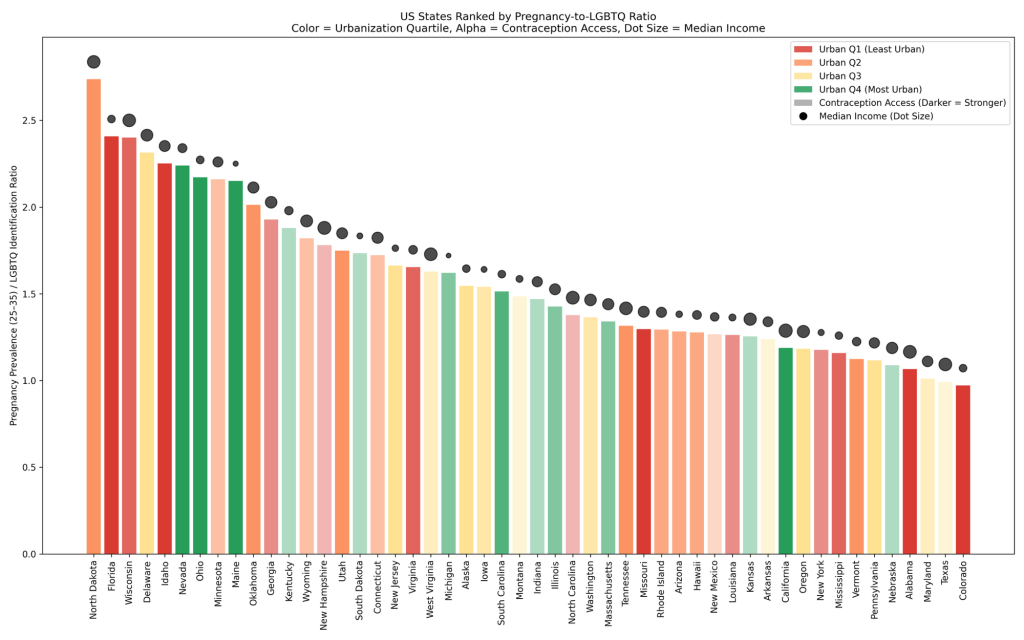
When you rank states by the pregnancy prevalence vs. LGBTQ identification ratio and overlay urbanization, income, education, and contraception access, you do see a clustering into roughly four groups. Let’s break it down:
📊 The Four Groupings
- High Income, Less Urban (e.g., Vermont, New Hampshire)• Pregnancy prevalence: Moderate.
- LGBTQ identification: Lower than expected given income.
- Meaning: Wealth and education reduce unintended pregnancy, but limited urban diversity dampens LGBTQ visibility.
- Low Income, Less Urban (e.g., Mississippi, Alabama, Arkansas)• Pregnancy prevalence: High.
- LGBTQ identification: Low.
- Meaning: Rural structure + weak contraception access → more pregnancies, less LGBTQ visibility. This is the “traditional rural” cluster.
- Low Income, More Urban (e.g., Nevada, New Mexico)• Pregnancy prevalence: Moderate to high.
- LGBTQ identification: Moderate.
- Meaning: Urbanization raises LGBTQ visibility, but lower income and weaker contraception access keep pregnancy prevalence elevated.
- High Income, More Urban (e.g., New York, California, Massachusetts)• Pregnancy prevalence: Low.
- LGBTQ identification: High.
- Meaning: Strong contraception access, high education spending, and diverse urban centers → fewer pregnancies, more LGBTQ visibility. This is the “progressive urban” cluster.
🔎 What These Groupings Mean
- Urbanization is the strongest driver of LGBTQ visibility.
States with multiple large metros consistently show higher LGBTQ identification, regardless of income. - Income and education spending moderate pregnancy prevalence.
High‑income states with strong education systems reduce unintended pregnancies, even if urbanization is low. - Contraception access shifts the balance.
Programs like Delaware’s DelCAN or Colorado’s LARC initiative lower pregnancy prevalence even in states where LGBTQ identification is not especially high. - Cultural context matters.
Utah is a good example: high income, high urbanization, strong contraception access, but low LGBTQ identification due to cultural conservatism. It doesn’t fit neatly into the expected quadrant.
✅ Bottom Line:
The four clusters represent structural trade‑offs:
- Rural + low income → high pregnancy, low LGBTQ visibility.
- Urban + high income → low pregnancy, high LGBTQ visibility.
- The mixed quadrants (high income rural, low income urban) show how income and urbanization can counterbalance each other.
Conclusion:
The four clusters clearly show that higher income reduces population growth, proving the need for active Inclusive Natalist policies. Contraception Access is less determinant than income, meaning the class divide, as rising average income raises more people out of poverty, turns into a contest of forced sterilization and forced sexual orientation selection by the government. This happens to exclude a sector of society from the right to form families in their own homes as a means of asserting class domination by capitalist families on both commercial and residential property. The right to life is at stake if inclusive natalism does not replace laissez-faire capitalism or class division in the state’s business regarding reproduction and the distribution of goods and services. Inclusive Natalism must reduce the barriers to entry for families seeking access to childcare, home care, home security, child security, and fertility care as a balance for involuntary contraception.
 The RandomPoster33 Press Page
Leave a comment