

Part 1: https://randomposter33.wordpress.com/2019/07/09/low-interest-hyper-deflation/
We can see clear proof that hyper-deflation has already reached extreme levels in the changing ratio of two measures, Money Supply and GDP. Ideally, to control inflation, the growth in money supply should equal the economic growth of the economy. As the number of goods produced and accumulated increases, the money supply should increase proportionately. What has actually happened?
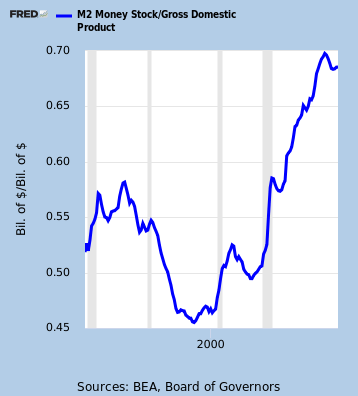
One can see that you have here an effective deflation of 60 to 80%, or the dollar has fallen in market value by 60 to 80%. That is, the amount of dollars increased by 60 to 80%, compared to quantity of goods produced. That means many more dollars are required to produce the same results.
Prices of goods, however, have not fallen 60 to 80%, and neither have exchange rates. This can only be explained by the exchange-rate regime combined with the massive trade deficit. Foreign countries sell their goods to the U.S. at fixed prices paid for in dollars, and because of the deficit, they are left with large reserves of dollars. If any country attempts to charge more for its exports, increase relatively low-cost production to increase exports, capturing market share, thereby sinking competitors, or empty their reserves of dollars, they will be labeled manipulators of currency, a threat to the strong dollar, and dealt with using “hard diplomacy.” Oil exporting countries especially face an open threat for raising their prices or increasing production beyond prescribed limits.
This has created a world-wide exchange-rate regime that has financed U.S. deficit spending at the expense of the economic development of exporting countries, as well as global economic growth. As GDP growth slows down into recessionary territory, a discussion will inevitably develop to plan the revaluing of the world’s currencies to reflect the changes in supply and demand, especially the fourfold increase in the real money supply of dollars, or the Federal Reserve Balance Sheet Assets, that occurred from 2005 to 2015.

A 60-80% decrease in prices should occur, including a reduction in wages. This could lead to mass starvation, homelessness, and economic bankruptcy. The alternative, within the capitalist system, would be for the US military, intelligence, and diplomats to maintain constant vigilance to prevent any central bank’s move in this direction. This system of coercion could lead to the destruction of world production. Instead, it should reveal, upon observation, the impossible immorality of the maintenance of the system and the economic necessity of organizing world production and politics under a single federal government dedicated to meeting the needs of and improving the living conditions of, as well as representing the democratic aspirations of the international working class. These social ends would replace the principle of defending private profit.


Leave a Reply